

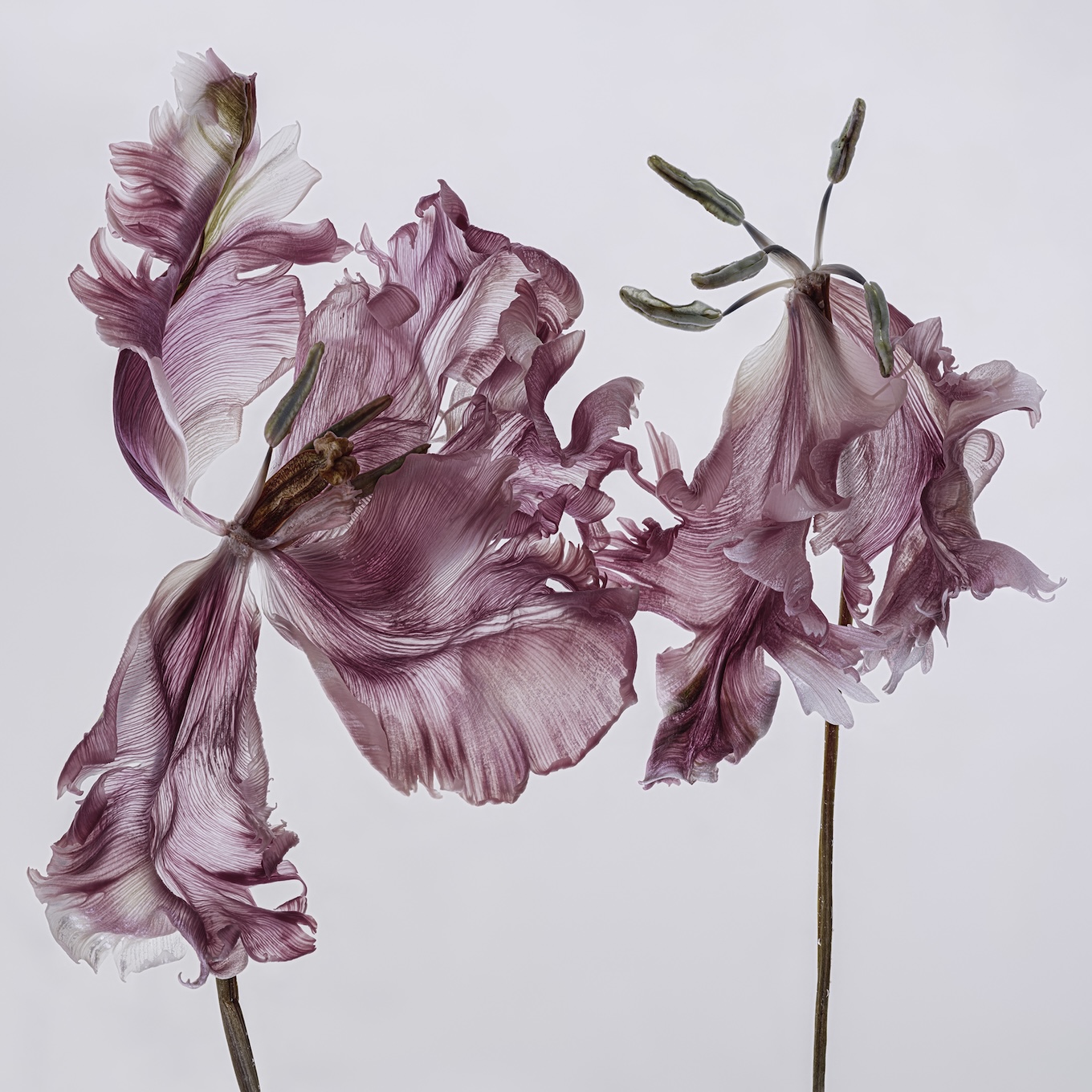
In earlier years, Kathrin Linkersdorff spent two years in Tokyo on a scholarship, immersing herself in Japanese culture and learning sumi-e, the traditional art of ink painting. During her time in Japan, she also encountered a profound approach to nature, one marked by reverence and attentiveness. Nature is seen as a living presence, and observing it is regarded as a path to spiritual insight.
It is therefore unsurprising that she chooses natural subjects for her experimental still lifes, aiming to capture the fleeting expression of perfection in decline. In line with Japanese philosophy, true beauty is often revealed through decay. For many years, Linkersdorff has explored processes such as drying, decolorizing, and soaking flowers, with tulips emerging as her most compelling subjects. As she extracted and explored the colors from their petals, the pigments emerged as a metaphor for life itself.
In her latest series, she turns to historic tulip varieties, including some of the oldest and once most prized breeds. The tulips’ thick, fleshy petals are transformed in her images into delicate, almost hand-drawn structures.
These heirloom tulips trace their lineage back to the 16th century and evoke the era of “Tulipomania,” when rare bulbs in 17th-century Netherlands fetched astronomical prices. The most coveted among them was the red-and-white Semper Augustus, whose striking patterns were not the result of breeding skill but of the tulip mosaic virus—a beauty born from fragility.
The tension between rarity, decay, and transience lies at the heart of Linkersdorff’s work.
Through her dialogue of past and present, Linkersdorff revives the tulip’s layered history, reimagining it as a symbol of ephemerality, renewal, and the cyclical interplay of nature, commerce, and art.
examples from the Fairies VIII series, 2025 – ongoing, archival pigment print